Numerical simulation · Engineering assessment · Industrial applications info@numericalarchive.com
← Back to Projects
Stepped gravity block quay wall with shear-keyed joints
Marine & ports · Nonlinear finite-element modelling

Gravity Block Quay Wall

A nonlinear finite-element model of a gravity block quay wall developed to investigate how lateral demand is transferred through stacked concrete blocks, shear-keyed joints and contact interfaces under pushover loading.

Gravity StructuresContact & FrictionShear KeysPushover Analysis
StructureGravity block quay wall
ModelNonlinear finite elements
InterfacesContact, friction & interlock
AssessmentLateral / seismic capacity
01 · Engineering scope

Modelling the quay wall as an interacting block system.

Gravity block quay walls do not resist lateral demand by self-weight alone. Their response also depends on the interaction between individual blocks, the geometry of the joints, friction and contact pressure, mechanical interlock at shear keys, and the development of sliding or rocking mechanisms.

What the model resolves

The finite-element representation is built to capture the structural mechanisms that occur between successive blocks rather than treating the quay wall as one monolithic body.

  • Block-to-block contact
  • Frictional sliding resistance
  • Shear-key bearing and interlock
  • Opening, rotation and local separation

What the assessment supports

The model provides a framework for investigating how the wall mobilizes resistance as lateral demand increases and where local interface behaviour begins to govern the global response.

  • Lateral load-transfer mechanisms
  • Pushover and capacity assessment
  • Potential sliding and rocking zones
  • Critical joints and force-transfer regions
02 · Structural configuration

From quay-wall geometry to a numerical structural model.

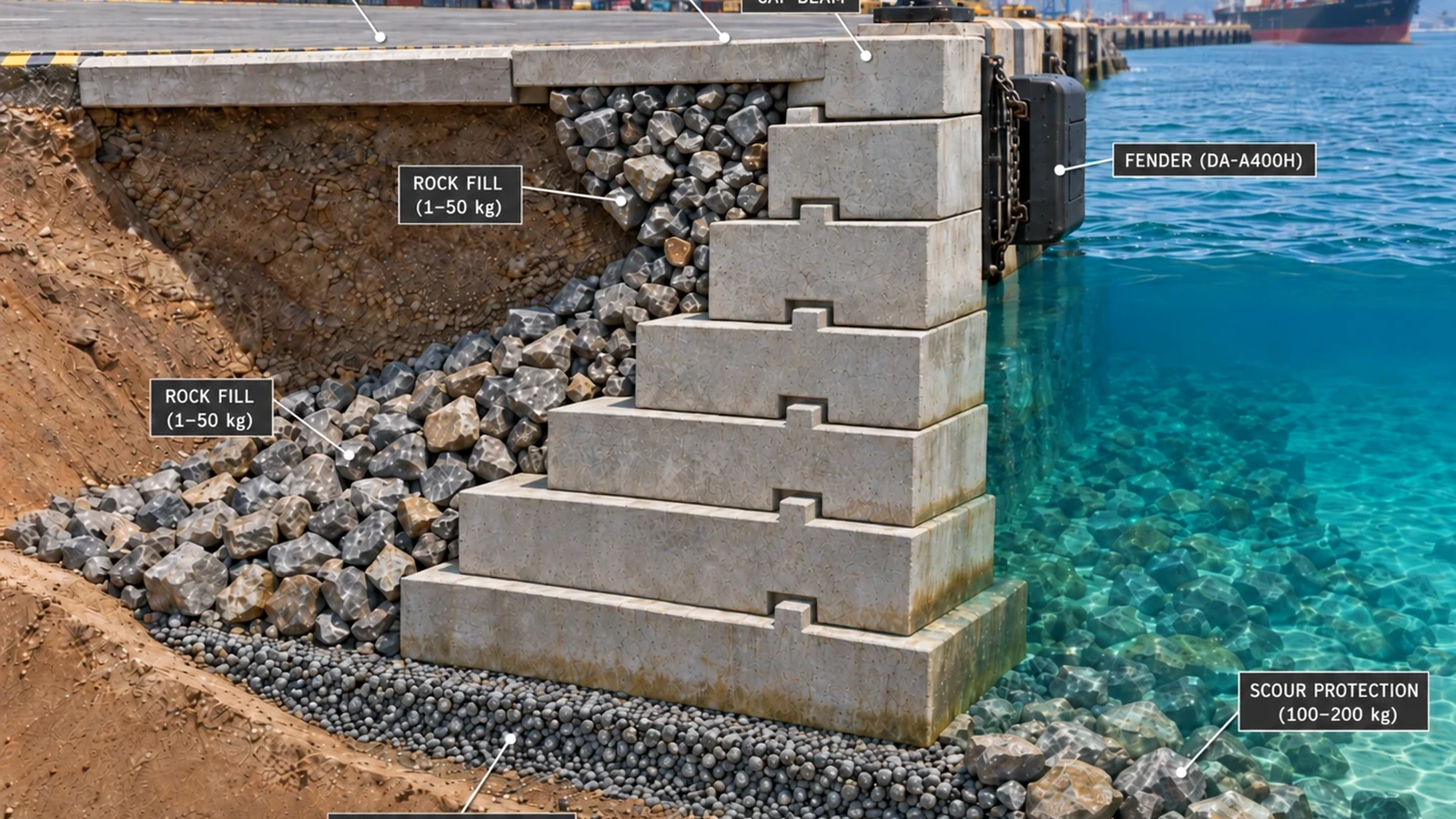
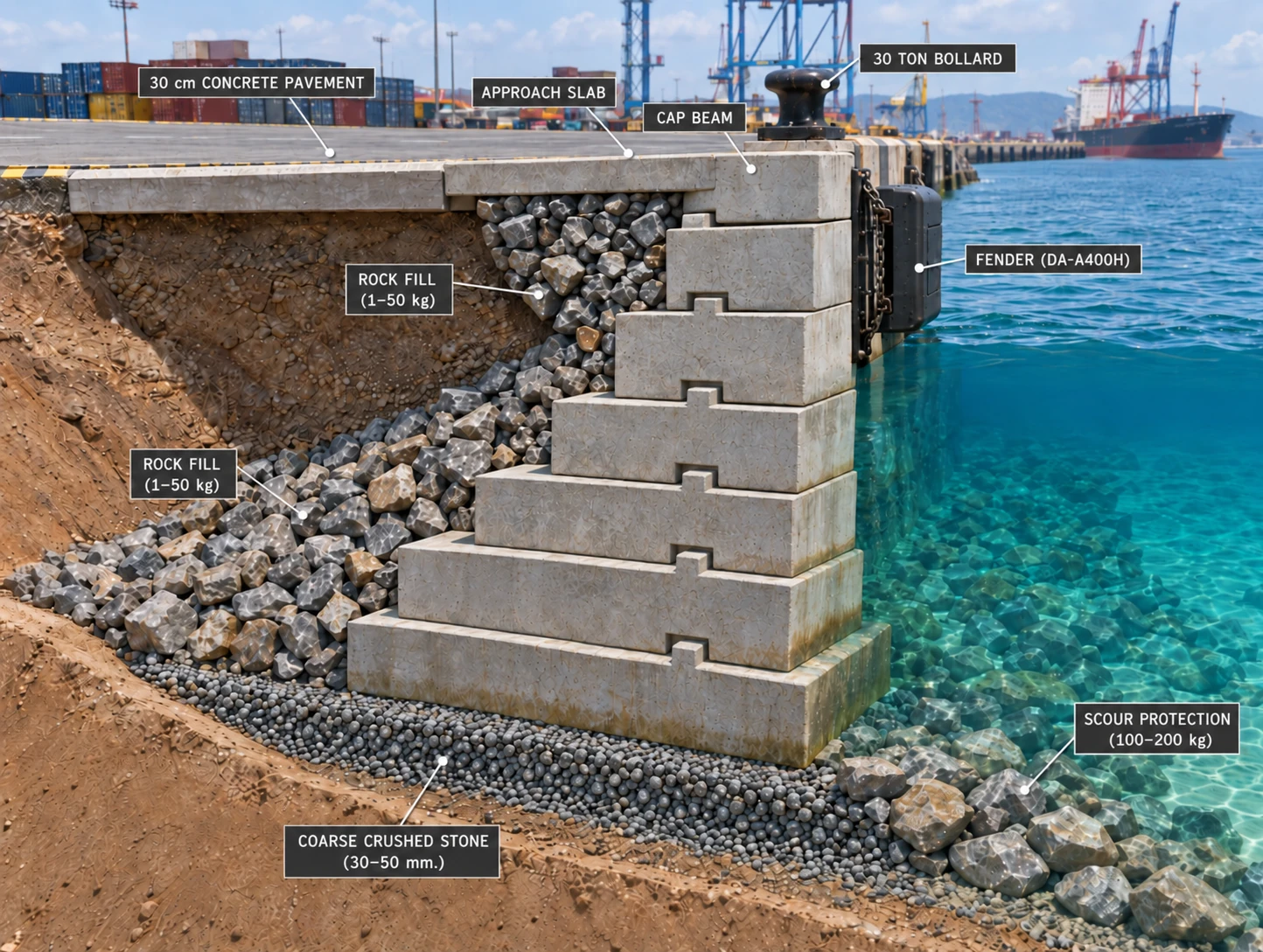
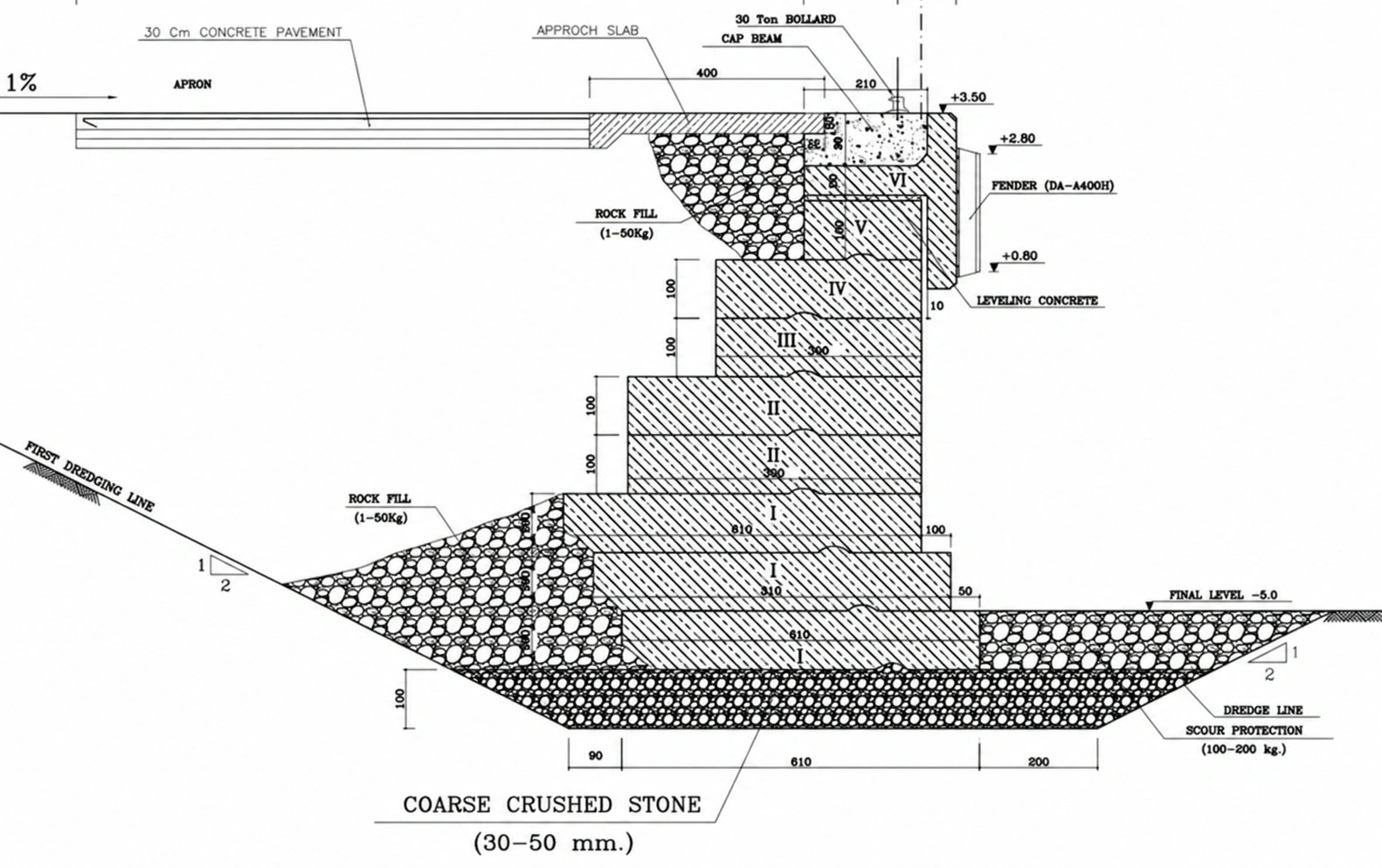
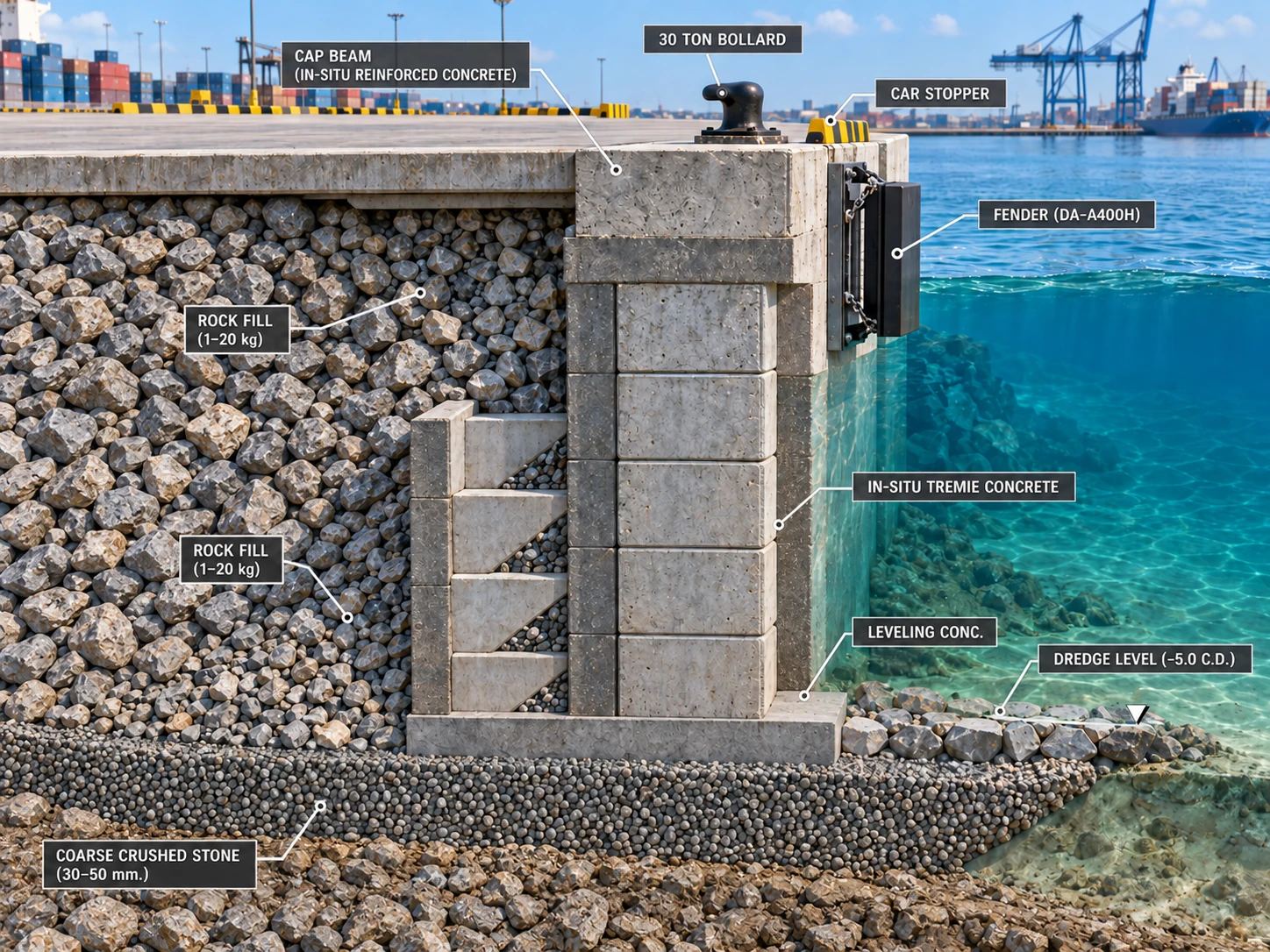
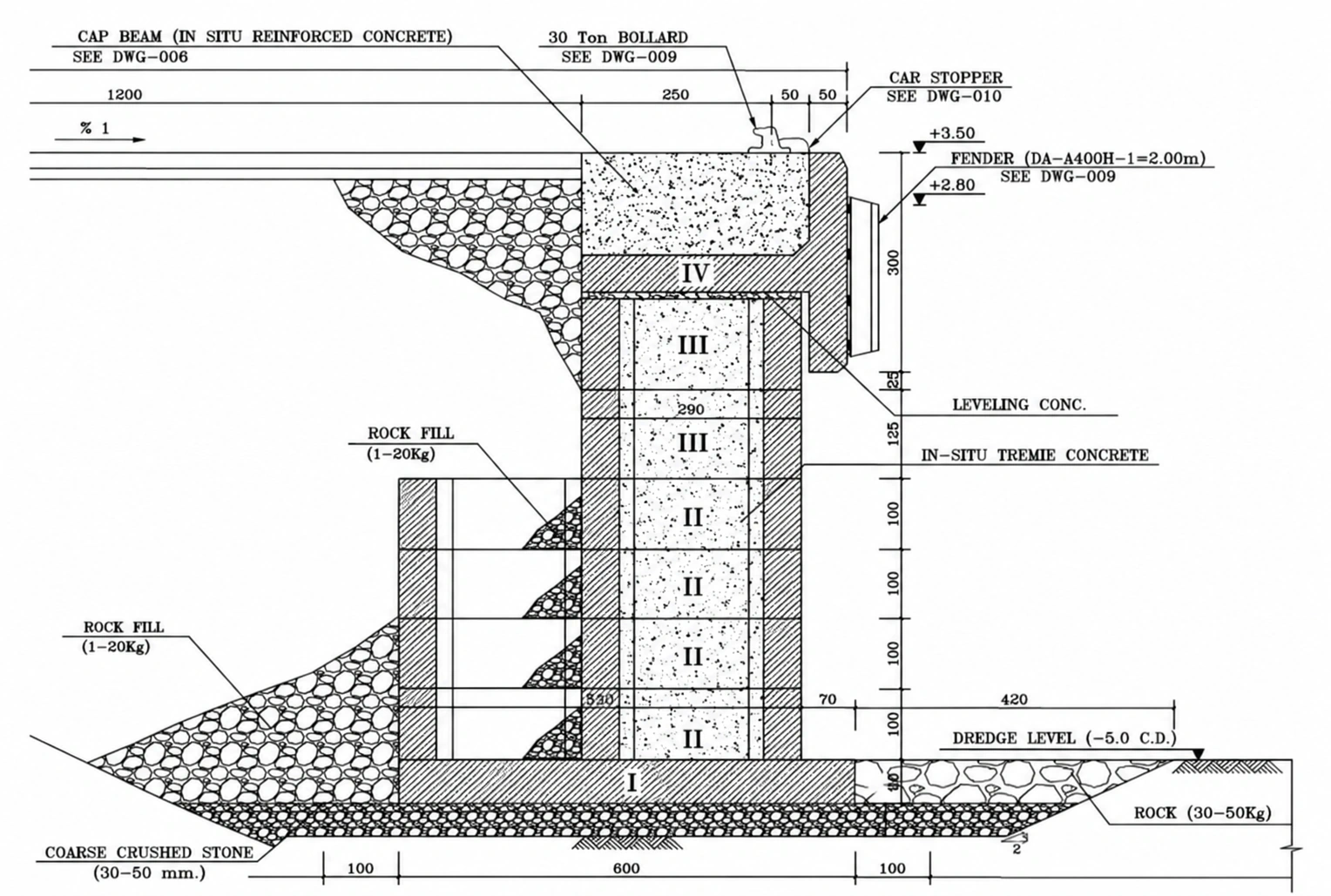
Gravity block quay walls can be built in different geometric arrangements. The visuals below pair each conceptual render with its corresponding engineering section so the geometry represented in the numerical model is immediately clear.

Stepped gravity block quay wall with visible shear-keyed joints
Engineering section of the stepped shear-keyed gravity block quay wall
Stepped gravity blocks with shear-keyed joints The rendered quay-wall concept and its corresponding structural section. The stepped geometry and interlocking joint detail are explicitly represented in the numerical model.
Vertical-faced gravity block quay wall with landward cellular block arrangement
Engineering section of the vertical-faced gravity block quay wall
Vertical-faced gravity block configuration A second representative gravity-wall geometry showing the relationship between the vertical quay face, stacked blocks, landward structural arrangement, backfill and foundation layers.
03 · Finite-element representation

Detailed modelling of the stepped, shear-keyed block system.

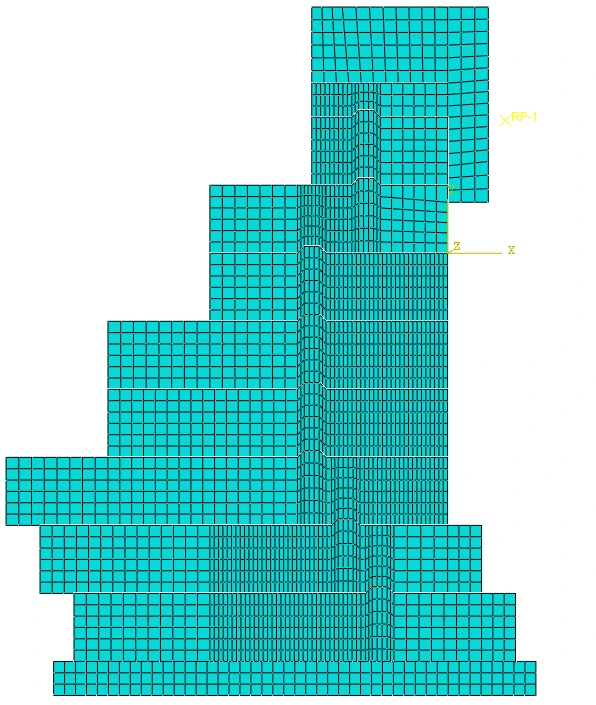
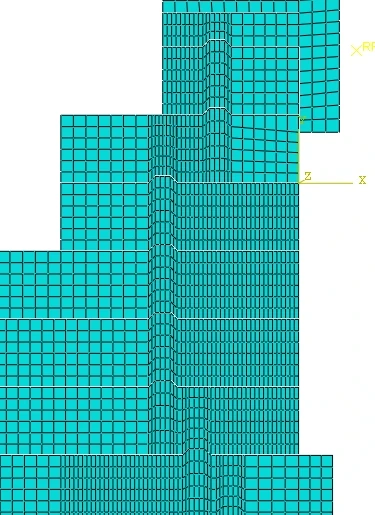
The finite-element mesh shown below belongs to the stepped quay-wall configuration above. Local refinement is concentrated around changes in block geometry and the interlocking interfaces, where contact state, local bearing and shear transfer require closer numerical resolution.

Finite-element mesh of the stepped shear-keyed gravity block quay wall
Global finite-element representation Stepped gravity blocks modelled as interacting structural components
Close-up finite-element mesh around stepped shear-keyed interfaces
Shear-key and joint-region detail Local mesh refinement around interlocking block interfaces and geometry transitions
04 · Numerical capabilities

One model can expose both global capacity and local joint behaviour.

The value of the analysis is not limited to a single capacity number. The same nonlinear model can be used to inspect the internal mechanics that produce the global response and to identify which interfaces or block movements deserve closer engineering attention.

01

Contact & friction

Track where blocks remain in compression, where contact redistributes and where frictional resistance is mobilized.

02

Joint opening & sliding

Identify interfaces that tend to open, slide or transfer increasing shear demand during lateral loading.

03

Block rotation & rocking

Evaluate how individual block movements contribute to the deformation mechanism of the complete wall.

04

Stress & load paths

Interpret principal stress trajectories, local bearing zones and the route by which lateral demand is transferred through the structure.

05

Pushover response

Develop the global base-shear–displacement response and relate changes in stiffness to evolving local mechanisms.

06

Seismic-capacity studies

Use nonlinear lateral analysis to investigate structural reserve, governing mechanisms and sensitivity to joint details.

05 · Engineering value

Numerical modelling makes the hidden mechanics visible.

For a gravity quay wall, the decisive behaviour may occur inside interfaces that cannot be understood from geometry or self-weight alone. A detailed finite-element model provides a way to connect the global capacity of the wall with the actual mechanisms developing between its blocks.

GlobalCapacity response
InterfaceContact & sliding
BlocksRotation & rocking
InternalLoad-transfer paths
Port & marine structures

Need to assess a quay wall or another joint-sensitive marine structure?

Share the geometry, loading scenario and engineering question. We can develop a numerical modelling strategy for structural assessment, capacity evaluation and mechanism identification.

Discuss Your Project
06 · Project video

See the numerical model and selected response fields in motion.

This short project video presents the quay-wall concept together with selected nonlinear finite-element outputs, illustrating the type of structural behaviour that can be explored through detailed numerical modelling.

Gravity block quay wall numerical study Structural concept · nonlinear FE model · selected response fields