Numerical simulation · Engineering assessment · Industrial applicationsinfo@numericalarchive.com
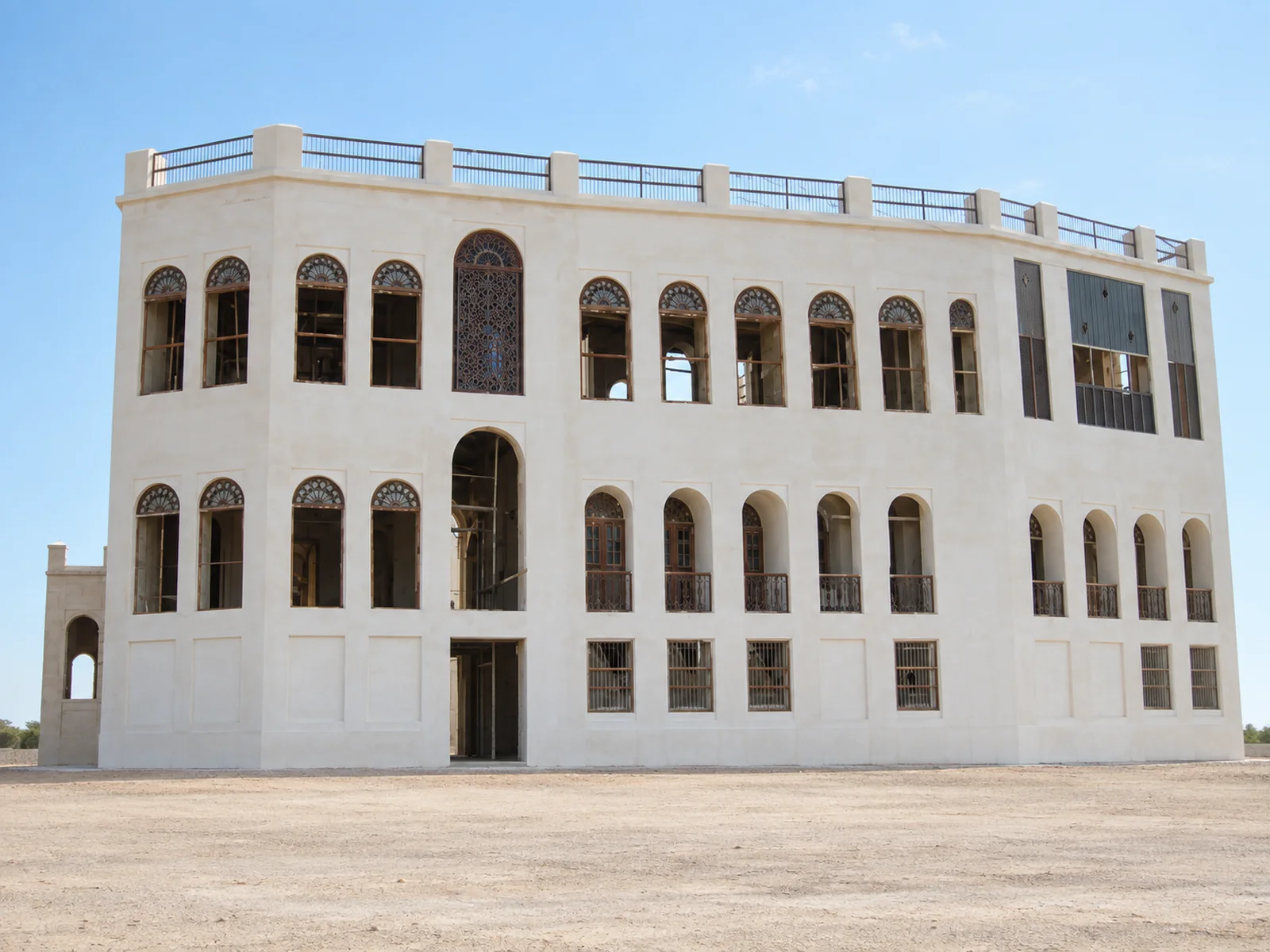
Historic masonry building in the Persian Gulf region
← Back to Projects
Confidential project · Persian Gulf region

Structural Assessment & Strengthening of a 300+ Year Historic Masonry Building

Advanced three-dimensional nonlinear analysis was used to investigate structural behaviour, identify vulnerable response mechanisms and support strengthening and rehabilitation decisions.

Historic MasonryABAQUSNonlinear FEAPushover AssessmentStrengthening Strategy
Project overview

Understanding behaviour before defining intervention.

A historic masonry structure of more than three centuries presented a complex combination of irregular geometry, multiple load paths, ageing materials, previous alterations and locally vulnerable structural components.

Numerical Archive and its technical engineering team developed a three-dimensional structural assessment workflow to understand the global response of the building and provide an analytical basis for strengthening and rehabilitation strategies.

StructureHistoric masonry building
RegionPersian Gulf
AgeMore than 300 years
Project statusConfidential
01 · Engineering challenge

A historic structure cannot be reduced to a textbook idealization.

Irregular wall geometry, openings, changes in elevation, uncertain connections, material ageing and historical modifications can alter the way gravity and lateral forces move through a masonry building. The assessment therefore focused on the structural system as an interconnected three-dimensional whole.

Existing-structure understanding

Available geometric, condition, material, foundation and structural information was combined to identify the principal load-bearing components and the dominant load-transfer paths.

  • Load-bearing masonry walls and piers
  • Openings, arches and discontinuities
  • Floor and roof participation
  • Foundation and supporting-ground behaviour
Assessment objective

The purpose was not to reproduce every architectural detail. The numerical model was developed to preserve the features that control structural response and to support engineering decisions about vulnerability and intervention.

  • Global structural behaviour
  • Critical response regions
  • Progression of nonlinear response
  • Strengthening priorities
02 · Numerical model

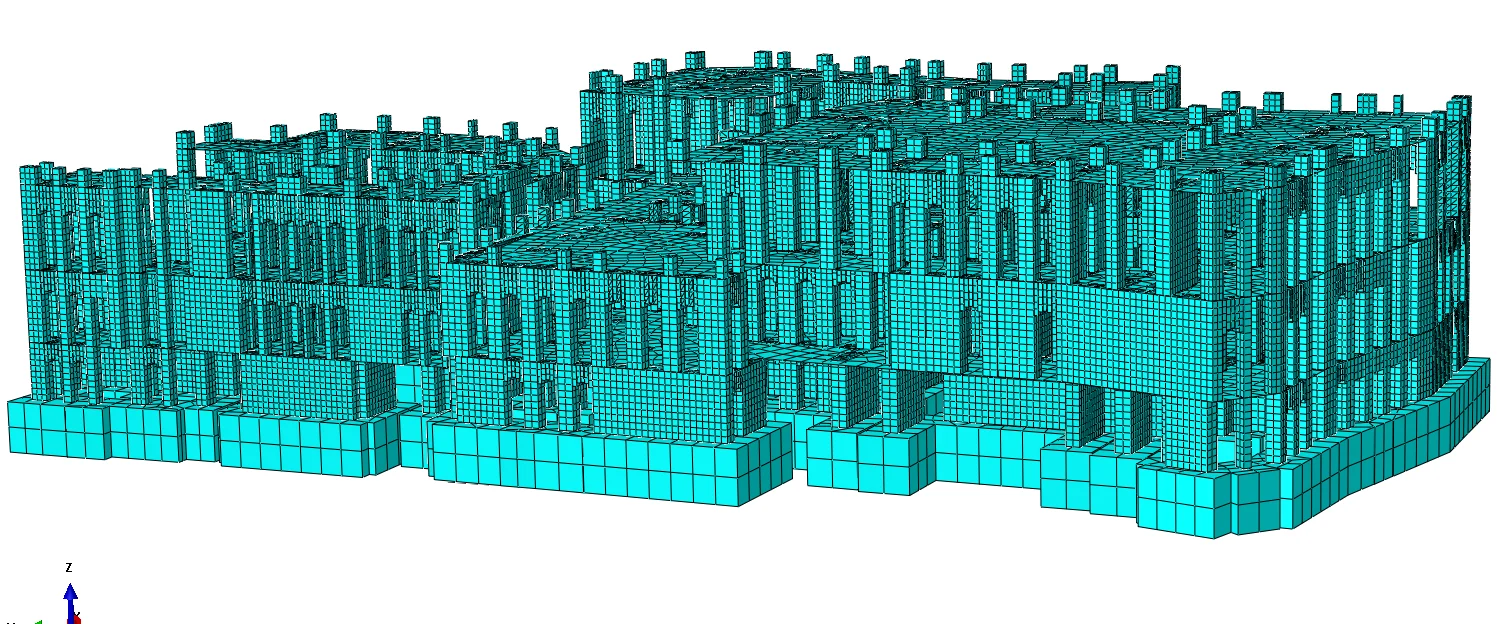
Three-dimensional nonlinear finite-element representation.

The principal masonry components were represented through a macro-modelling approach so that the overall structural system could be analysed without explicitly modelling each individual stone or mortar joint.

Three-dimensional finite-element mesh of the historic masonry structure
Three-dimensional structural model and finite-element meshRepresentative geometry · masonry macro-modelling · global load paths
03 · Analysis strategy

Gravity state first. Nonlinear lateral behaviour second.

The analysis sequence established the structural state under gravity loading and then followed the building response under controlled lateral displacement. This allowed the engineering team to observe stiffness changes, force redistribution and the development of nonlinear response.

Gravity response

The gravity stage was used to evaluate load transfer, establish the initial stress state and identify areas in which geometry or structural discontinuity produced concentrated demand before lateral loading was introduced.

Nonlinear lateral assessment

A displacement-controlled pushover strategy was used to trace the progression of structural response beyond the initial range and identify regions that increasingly governed the global behaviour of the building.

04 · Response interpretation

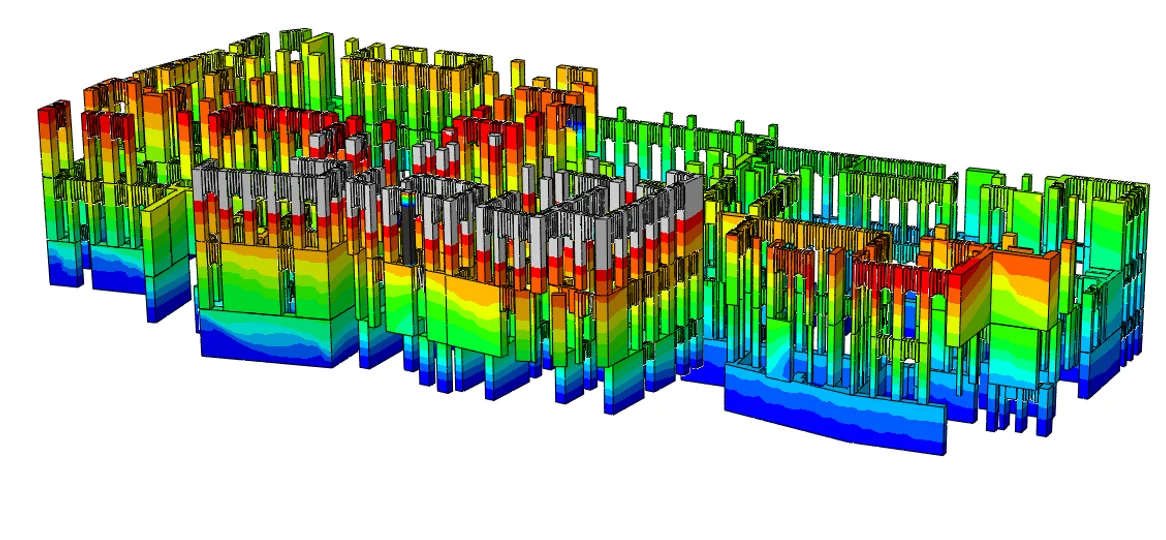
Results were interpreted as behaviour—not just contour plots.

Numerical outputs were reviewed across different stages of response to distinguish local peaks from meaningful structural patterns and to identify areas where deformation, stress concentration and nonlinear behaviour became relevant to engineering decisions.

Finite-element response contour of the historic masonry structure
Representative global response fieldProject-specific numerical values intentionally withheld
05 · Engineering outcome

Using numerical evidence to guide strengthening decisions.

The model was used as a decision-support tool. Critical regions identified numerically were considered together with the known condition of the structure so that intervention concepts could be focused where structural evidence justified them.

Existing EvidenceGeometry, condition and available project data
3D ReconstructionPrincipal load-bearing components
Nonlinear ModelRepresentative masonry response
Structural AnalysisGravity and lateral behaviour
Critical RegionsResponse mechanisms and priorities
StrengtheningTargeted engineering interventions
Project confidentiality

Client identity, exact project location, detailed drawings, dimensions, numerical capacity values and other sensitive project information are intentionally withheld. This case study is presented to demonstrate the engineering methodology and technical capabilities applied by Numerical Archive.

Similar engineering challenge?

Discuss your structure with our technical team.

If your project involves an existing structure, nonlinear behaviour, complex load paths or strengthening alternatives, we can help define an appropriate modelling and assessment strategy.

Discuss Your Project