Numerical simulation · Engineering assessment · Industrial applicationsinfo@numericalarchive.com
Large utility-scale wind turbines
← Back to Projects
Energy structures · Applied numerical study

Wind Turbine

A large-scale finite-element model was developed to study the global structural behaviour of the tower, blades and rotor assembly and to support evaluation of load transfer, deformation and critical response regions.

15 MW ClassWind EnergyFinite-Element ModellingStructural ResponseLarge-Scale System
Project overview

Representing a very large energy structure as an integrated numerical system.

Large wind turbines combine a slender tower, long flexible blades and a concentrated rotor–nacelle assembly in a structural system whose response is governed by geometry, stiffness distribution, mass and the transfer of loads between highly dissimilar components.

Numerical Archive developed a three-dimensional finite-element study for a turbine in the 15 MW class. The model was prepared to investigate global structural response, load transfer and deformation while keeping the manufacturer, location and reference-model identity confidential.

SystemWind turbine
Capacity class15 MW
ScopeTower · blades · rotor
IdentityWithheld
01 · Engineering challenge

Scale, flexibility and load transfer govern the problem.

At this scale, the structural system cannot be understood by looking at the tower or blades in isolation. The response depends on how gravity, wind-related actions, rotor loads and stiffness changes move through the assembled turbine.

System-level behaviour

The model represents the main structural components as a connected assembly so that deformation and load transfer can be interpreted at the scale of the complete turbine.

  • Slender tower response
  • Long flexible blades
  • Rotor–nacelle load transfer
  • Geometric compatibility between components
Assessment objective

The study focuses on the behaviour that is most useful for engineering interpretation rather than reproducing every manufacturing detail of the machine.

  • Global deformation pattern
  • Stress distribution
  • Critical connection regions
  • Large-scale structural response
02 · Finite-element representation

Three-dimensional model of the principal turbine components.

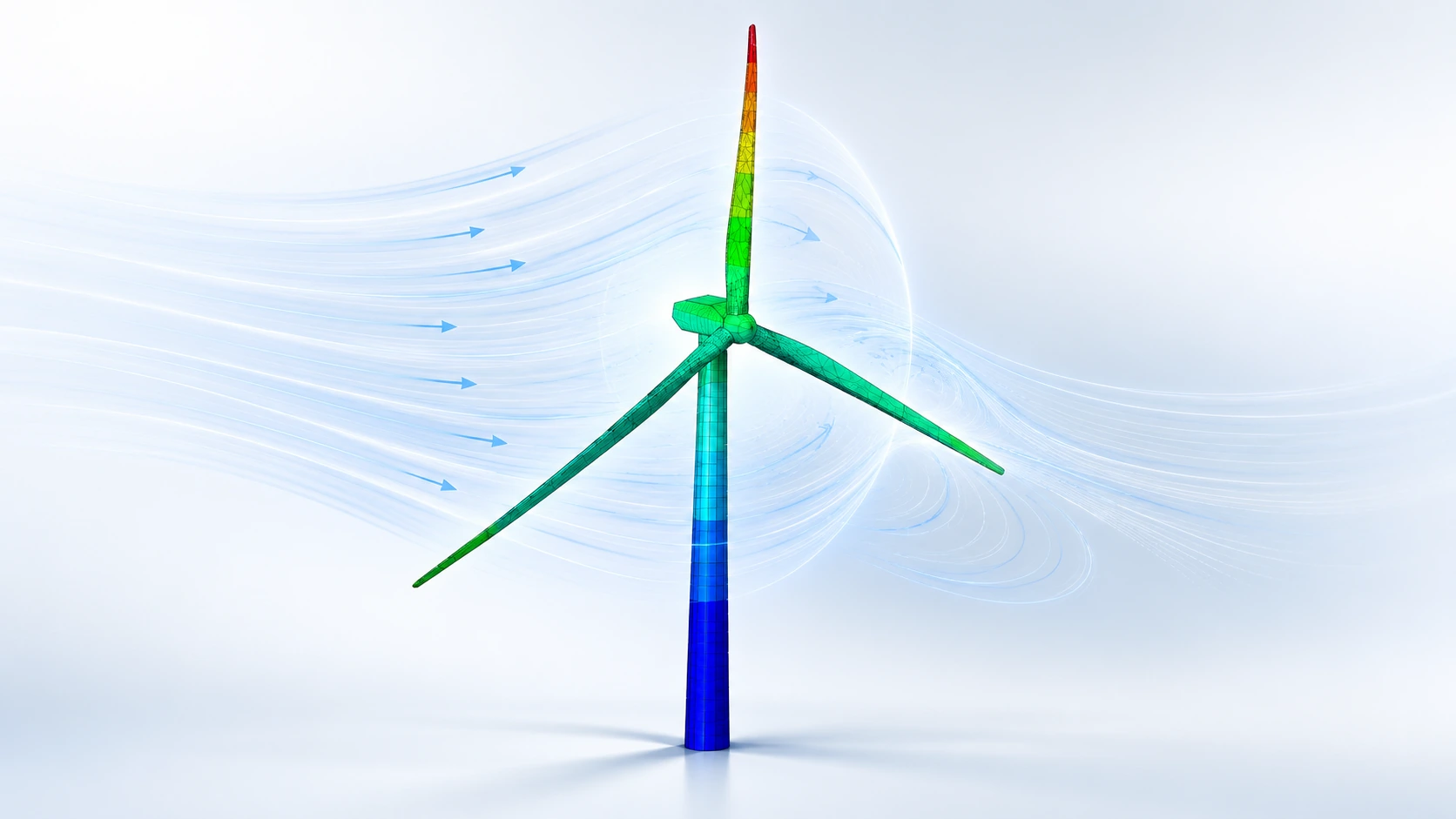
The tower, rotor region and blades were represented in a unified finite-element model. Mesh density and geometric detail were concentrated where changes in stiffness, load transfer and local connectivity required closer representation.

Global finite-element model of a 15 MW wind turbine
Global turbine finite-element representationLarge-scale geometry · integrated tower, rotor and blades
03 · Mesh & component detail

Closer resolution at the rotor and blade interfaces.

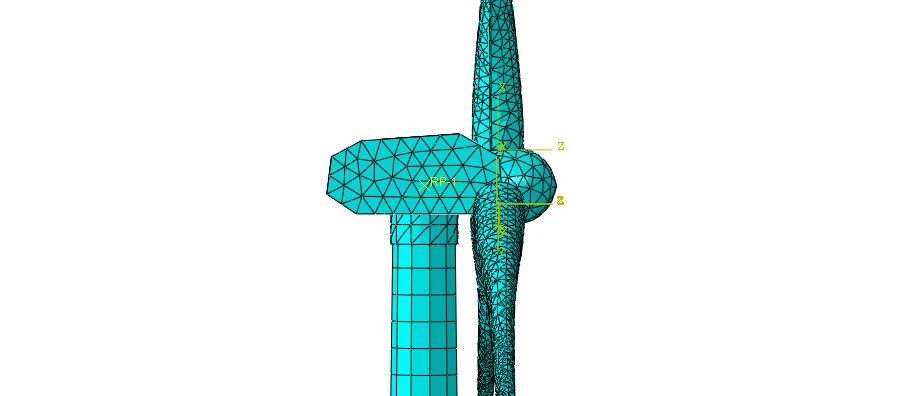
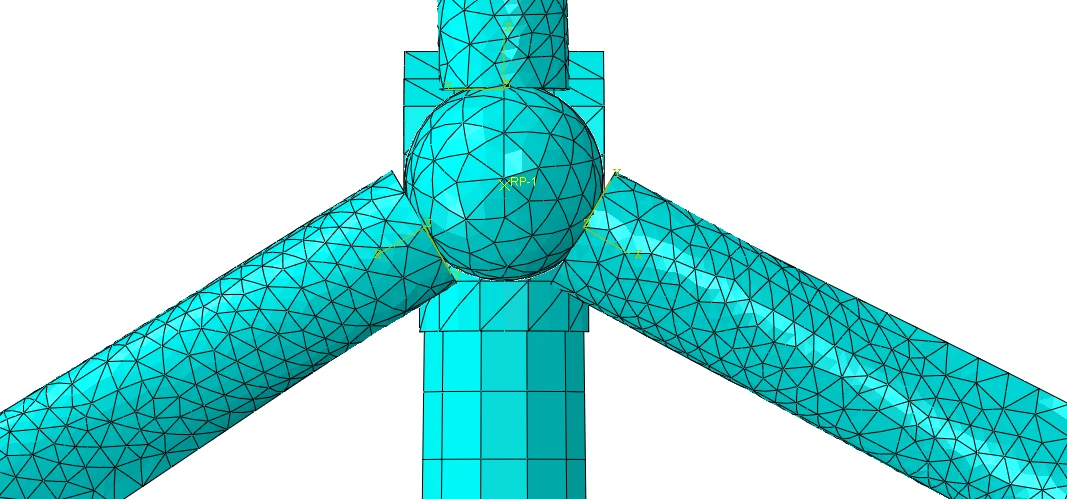
Detailed views of the model show the finite-element discretization around the rotor, hub and blade-root regions, where geometry and connection conditions strongly influence the way forces are transferred into the tower.

Finite-element mesh around the nacelle and blade region
Nacelle and blade-region meshComponent connectivity · local discretization
Finite-element mesh of the rotor hub and blade roots
Rotor hub and blade-root representationLoad-transfer region · geometric detail
04 · Loading & response

Evaluating structural response under representative turbine actions.

The numerical framework was developed to support assessment under self-weight, representative wind-related actions and operational loading. The resulting response can be used to examine deformation, stress distribution, force paths and vibration-related behaviour across the assembled system.

ResponseGlobal deformation
ResponseStress distribution
MechanismLoad transfer
SystemVibration-related behaviour
05 · Engineering value

Using simulation to screen behaviour before costly physical testing.

For very large energy systems, numerical analysis provides a practical way to understand response, identify sensitive regions and compare design assumptions before more expensive testing or detailed design stages are undertaken.

System DefinitionPrincipal turbine components and geometry
3D ModelTower, rotor region and blades
Finite-Element MeshGlobal and locally refined discretization
Representative LoadsGravity, wind-related and operational actions
Response ReviewStress, deformation and load transfer
Engineering InsightCritical regions and model refinement
Technical confidentiality

The turbine manufacturer, exact reference model, site, country, detailed dimensions and project-specific parameters are intentionally withheld. This case study is presented to demonstrate Numerical Archive's capability in large-scale wind-energy modelling and structural-response assessment.

Wind or energy structure?

Discuss your numerical modelling challenge.

If your project involves large-scale energy structures, flexible components, dynamic sensitivity or complex load transfer, our technical team can help define an appropriate finite-element modelling and assessment strategy.

Discuss Your Project